Silver Bookmarks

Advanced Search
0 ItemsSubtotal: $0.00
View Cart
Login
HomeAboutHallmarksReferencesRelated SitesCommentsContact Us
Advanced Search
HomeAboutFavoritesHallmarksReferencesRelated SitesCommentsContact Us
All Bookmarks
Favorites
Sold
Scan QR Code New!
Funny Names New!
Browse by Bookmark
Browse by Group
Browse by Category
Welcome to Silver Bookmarks

Here you will find a reference site of antique silver (among other materials) bookmarks. There are over 1200 pieces and are displayed with an interactive catalog where all bookmarks are numbered and can be seen enlarged with a picture of any hallmark they may have. Browse by number, group, material, origin, manufacturer, shape, style or date or search by text.
More about this site...
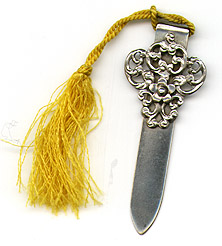
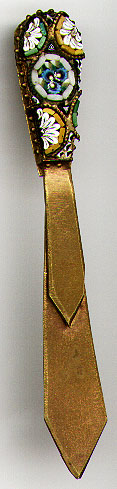
Random Bookmarks from the Collection
All Bookmarks->
This bookmark was made in China. It is made of tin and enamel paint and is red with a Chinese symbol on the top. Written underneath the symbol is "Good Luck". The date is 1970 - 1980.
More info...
This bookmark was made in Sweden. It is marked 800 and the letter S. It is a silver top and either a celluloid or a casein blade. It is more a page cutter than a bookmark but can be used as either. The date is 1910 - 1920.
More info...
This bookmark was made in France by an unknown manufacturer. It is a colorful enamel and brass cloisonne piece know as Battersea. The date is 1900 - 1910.
More info...
This bookmark is from Birmingham, England. It is marked G.E.W with a date mark of "e" indicating the year 1904. The top is silver and the blades are mother of pearl.
More info...
 This bookmark was made in the US by Woodside Sterling Co. It is marked sterling 1352 along with the manufacturers hallmark. It is an art nouveau design with a fancy fleur-de-lis on top.
This bookmark was made in the US by Woodside Sterling Co. It is marked sterling 1352 along with the manufacturers hallmark. It is an art nouveau design with a fancy fleur-de-lis on top.
More info...
This bookmark is American made and is marked Sterling. The top is in the shape of an art nouveau womans head. It was manufactured in the early 1900's.
More info...
 This bookmark was made in the US by Tiffany and Co. It is marked Tiffany and Co. Makers Sterling. The top has the bust of a very detailed bald eagle. The date is 1950 - 1960.
This bookmark was made in the US by Tiffany and Co. It is marked Tiffany and Co. Makers Sterling. The top has the bust of a very detailed bald eagle. The date is 1950 - 1960.
More info...
This bookmark was made in England. It is a piece of Tunbridge Ware. "Tunbridge ware is a form of decoratively inlaid woodwork characteristic of the spa town of Tunbridge Wells in Kent in the 18th and 19th centuries. The decoration typically comprises a mosaic of many very small pieces of different coloured woods that form a pictorial vignette. Shaped rods and slivers of wood were first carefully glued together, then cut into many thin slices of identical pictorial veneer with a fine saw. Elaborately striped and feathered bandings for framing were pre-formed in a similar fashion." The date is 1880 - 1900.
More info...